
Whose Treasure Is It Anyway?
“One person’s trash is another person’s treasure.”
It’s one of those sayings we hear so often it almost disappears into the background. But the more I sit with it, the more I realize it touches almost every corner of life. Treasure isn’t always shiny. Sometimes it’s ordinary, even laughable, until you look closer.
I think of Casper the Friendly Ghost, when the great “treasure” turned out to be nothing more than a ball and a glove. Most people would have shrugged and tossed them aside. But for someone, those two objects carried an entire world of memory, love, and belonging. The ball and glove weren’t just “things.” They were connection, they were story.
That’s the thing about value — it isn’t fixed. It moves with us.
Looking Again, Slowly
A pot of gold is only worth what someone is willing to pay. A quilt might look like scraps to one person, but to another it is warmth stitched with love. Even in art, a stray line can look like a mistake until suddenly it’s the very thing that makes the piece come alive.
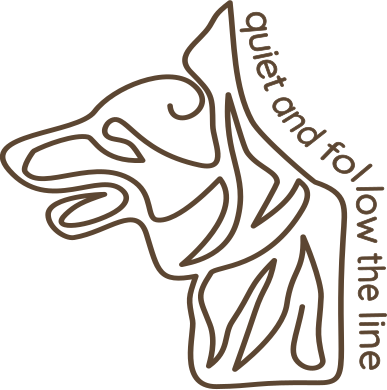
My line drawings are like that. At first glance, they might look simple—just a line meandering across the page. But every curve, every pause, every turn carries the story of the moment it was drawn. A shaky hand on a hard day. A smooth, flowing stroke on a peaceful one. To someone else, it might just look like ink. To me, it is a record of breath and being.
So much of life is like that — misunderstood until the right eyes or the right season sees it clearly.
Pause here for yourself:
- What are you holding that others might not understand?
- Can you let it be treasure anyway?
When Value Changes Hands
History gives us plenty of reminders about how selective we are in what we call valuable.
Van Gogh poured his heart into canvas after canvas, often in poverty and pain, selling almost nothing while alive. He relied on his brother’s support, carried the ache of being dismissed, and still kept painting. Today his work is celebrated as some of the most brilliant art ever created.
Modigliani’s portraits, Vermeer’s quiet rooms, Cézanne’s still lifes—all overlooked in their lifetimes, now revered and sold for millions.
And then Picasso. He lived to see his own fame. By midlife, his paintings were already fetching high prices. He became wealthy and known, a celebrity in his own right.
The art didn’t change. The eyes looking at it did.
Isn’t that the way with our own lives, too? What feels overlooked today might hold its meaning later. Sometimes we are both the artist and the latecomer to our own recognition. Sometimes our own treasures need time to ripen before even we can see them clearly.
Reflection:
- What might you be creating now that only makes sense later?
- How much of your worth are you measuring by applause instead of alignment?
The Quiet Things We Keep
Not all treasures hang in galleries or sell for millions. Most of them live quietly in drawers and memory boxes.
A note tucked away.
A rock from a walk.
A child’s drawing.
A prayer whispered in ink.
I think of the way a child will hand you a bent dandelion and call it a flower for your table. To anyone else, it’s just a weed. To you, it’s love, handed in the form of yellow petals. That’s treasure.
My line art feels like that too—single strokes that may look like nothing to others, but for me, they carry whole seasons of thought and healing. They are proof that even the simplest gesture can hold more than meets the eye.
Even in faith, we’re reminded to “store up treasures in heaven.” I’m not talking here about eternity after death, but about where we put our heart right now. What we invest our love in. What cannot be stolen.
Something to consider:
- Which “ordinary” thing in your life carries extraordinary meaning?
- Are you giving yourself permission to treasure it fully?
Choosing What Matters Anyway
There will always be critics and naysayers, ready to measure what matters and what doesn’t. But critics can’t touch the private weight of what we carry in love. Treasure is selective, chosen.
In my art, I choose to keep following the line, even when it wobbles. In life, I choose the memory that steadies me, the ritual that returns me to myself, the treasures that seem too small to mention but carry me through.
The worth isn’t in the glitter. It’s in the keeping.
Questions for you:
- Whose voice is pricing your treasures—yours or someone else’s?
- If you stopped defending what you love, what would you hold closer?
A Final Wondering
In the end, treasure isn’t about money or approval. It’s about what steadies us, what lights us up, what brings us back to love. It’s about what we choose to keep close, even when the world would throw it away.
So maybe the better question isn’t what is treasure?
Maybe it’s what do you love enough to call treasure?
And maybe—just maybe—those single lines I draw, (click here for My Line Art) the ones that look like nothing to someone else, are my own quiet proof that treasure is everywhere.


